Sibyl
A multi-agent system that checks sustainability reports against real-world evidence
1st Place & Best Use of AI/ML · Hack for Humanity 2026
Timeline
One month, Hack for Humanity 2026
Tools
Python · FastAPI · LangGraph · PostgreSQL · pgvector · React · TypeScript · OpenRouter
Overview
Sibyl reads a corporate sustainability report and checks every claim in it against real-world evidence. It produces a paragraph-level IFRS S1/S2 compliance report that shows what a company claims and what it chose to leave out.
We built it in a month for Hack for Humanity 2026, where it won 1st Place and Best Use of AI/ML. Nothing in it is mocked. It parses real PDFs, pulls real satellite imagery, searches real news and research, and maps every finding to the actual standard.
01
The Problem
Sustainability reports run 100 to 200 pages of claims about emissions cuts, net-zero targets and governance, and they steer trillions of dollars in ESG investment. A 2020 European Commission study found that more than half of green claims were vague or misleading, and 40% had no support at all.
Since January 2024 the IFRS S1 and S2 standards require specific disclosures across governance, strategy, risk management, and metrics and targets. But no tool checked whether the claims behind those disclosures held up.
Greenwashing isn't only invented claims. It's also strategic omission, like quietly dropping Scope 3 emissions from a report. We designed Sibyl to catch both.
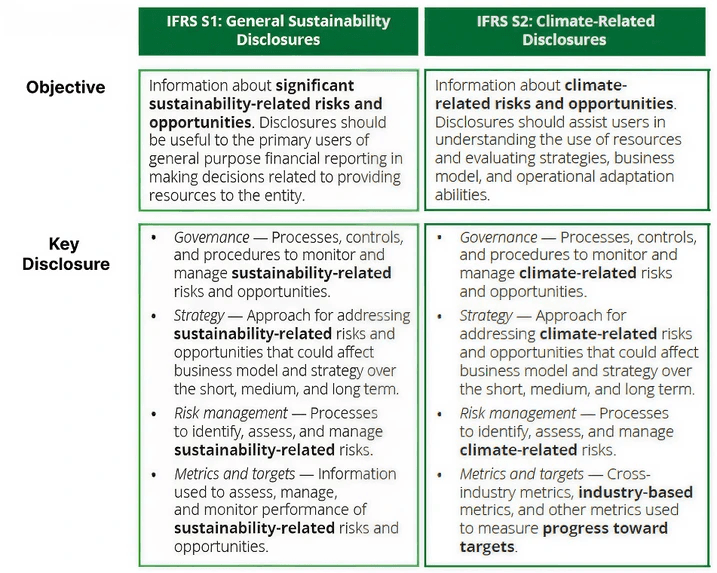
The two standards Sibyl checks against. S1 sets how disclosures are structured, S2 sets what to disclose about climate.
02
System Design
Sibyl is a LangGraph state machine. A report moves through five phases, sequential at first and then parallel. Click through them below.
Extract the claims
The claims agent reads the whole parsed report in one pass and tags every verifiable claim with its type, page and likely IFRS paragraph.
The core design choice is that specialists never talk to each other directly. When one needs context from another domain, it posts a request to the shared state. The orchestrator spots it, routes it to the right agent, and the answer lands back in the same state. Every node reads and writes one schema, checkpointed to Postgres after each step, so a failed run resumes from the last good node.
class SibylState(BaseModel):report_id: strclaims: list[Claim] # from the claims agentrouting_plan: list[RoutingAssignment] # from the orchestratorfindings: list[AgentFinding] # from the specialistsinfo_requests: list[InfoRequest] # cross-domain questionsinfo_responses: list[InfoResponse] # and their answersverdicts: list[ClaimVerdict] # from the judgereinvestigation_requests: list[ReinvestigationRequest]iteration_count: int # capped at 3events: list[StreamEvent] # streamed to the dashboard
03
The Agents
Eight agents, each with one job and the model best suited to it. Hover or tap one to see what it does.
Judy the judge agent
Claude Opus 4.5Scores the evidence and issues a verdict, or sends the claim back with what's missing.
04
Earning a Verdict
We didn't want a system that just sounds confident. Every verdict has to clear an explicit bar, and evidence is scored rather than taken at face value. The judge rates each claim on four weighted dimensions.
A claim scoring above 0.7 gets a verdict. Below that, the judge doesn't guess. It sends a targeted re-investigation request back through the orchestrator, naming which agents should look again, the exact gap, and what would count as enough. After three cycles a verdict is forced.
The specialists hold their own evidence to a standard too.
How much a news source counts
4×
Investigative journalism and regulators
3×
Established outlets
2×
Press releases
0×
Social media, ignored
Kinds of contradiction
Math the model never does
Totals and reduction rates run through a calculator tool, so the numbers are right by construction.
safe_eval("(baseline - current) / baseline")05
Design Decisions
One context window juggling satellite imagery, legal text, emissions math and news coverage dilutes attention and gives inconsistent answers. Each specialist only sees the claims in its domain, like a real investigative team.
06
The Interface
A multi-agent system is hard to trust when you can't see it work. The Detective Dashboard turns each agent into an animated avatar in a small village built on React Flow. As the run streams in, claims travel between agents as animated edges, cross-domain requests collect in a shared message pool in the middle, and each agent's live reasoning pulses underneath it.
The output is the Source of Truth report, organized by IFRS pillar. Every claim card shows its verdict, the evidence from each agent and the full reasoning chain. Hovering an IFRS tag like S2.14(a)(iv) shows the actual requirement, and each pillar ends with a list of what the report never disclosed.
We gave it a warm cream palette on purpose, so it reads like a document you review rather than another dark monitoring dashboard.
07
Conclusion
Sibyl checks a sustainability report the way an investigative team would. Each specialist owns one kind of evidence, the judge holds every verdict to an explicit bar and sends weak claims back, and the dashboard shows the whole investigation as it runs.
We built it in a month, and it won 1st Place and Best Use of AI/ML at Hack for Humanity 2026.